
Precision Cooling: this is how a data center is modernized without interrupting its operation.
STULZ KNOW-HOW
Global Switch's data center in Madrid has carried out an ambitious renovation of its cooling system without interrupting its customers' activities. Using advanced precision air conditioning solutions provided by STULZ, combining inverter CRACs, fanwalls, free cooling, and intelligent control, it has achieved energy savings of 20% and reduced the share of cooling in the building's total consumption from 24% to 9% under optimal conditions. This complex technical achievement anticipates the needs of the rapidly growing sector.

1. MADRID AS A STRATEGIC LOCATION
Spain's geographical position has made it an ideal location for developing this market, becoming one of the most important European hubs. The country's growth, with forecasts reaching 700 MW in 2029, paints a picture in which innovation in cooling will become increasingly decisive.
In particular, Madrid has established itself as a strategic location for critical service operators, where energy efficiency and operational security are key differentiators.
In this context, Global Switch has been in the city for more than two decades, ensuring the continuity and reliability of operations for large business and technology customers.
The Global Switch data center in Madrid is an example of technological adaptation in response to the progressive increase in computing densities. This growth has made it necessary to redesign its cooling systems in order to maintain efficiency and safety standards in line with current market demands. To achieve this, Global Switch has relied on STULZ’s climate control solutions, an international provider specialized in HVAC for mission-critical applications.
As Markel Gruber, Managing Director of Global Switch, points out, “We guarantee five nines of electro-mechanical continuity.” The entire facility is redundant, both in terms of electrical infrastructure and cooling.
The challenge, therefore, was not only technical but also strategic: to upgrade an active infrastructure without affecting the service of highly demanding clients such as payment companies, banks, or gaming and streaming platforms.

2. DESCRIPTION OF THE DATA CENTER
Global Switch's data center in Madrid has been operational for more than two decades and has undergone continuous evolution in terms of capacity and technology. The building consists of three main floors, a basement, and an annex building for energy. In total, the property covers 22,000 square meters, with 12,000 square meters of space dedicated exclusively to the technical area. As its manager explains, “when we started 20 years ago, data centers were not yet a sector, they were not an industry as they are today, each floor looked like an empty football field; today it has become too small for us.”
Over the years, the progressive increase in energy density has set the pace for the transformation of the data center. Initially, the racks handled loads of around 3 kW, a figure that increased to 5-6 kW around 2010 and now reaches 8-9 kW per rack. The new building, currently in the design phase, envisages loads of between 30 and 50 kW, with short-term forecasts that could reach 600 kW per rack due to advances in computing and artificial intelligence.
This growth has also brought a significant structural challenge. “We had to underpin the building twice, reinforcing the foundations with steel and concrete to support the additional weight of new cooling units,” explains Gruber. Cooling needs have not only increased in scale but also in complexity, requiring adaptable, efficient, and scalable solutions.

3. STULZ TECHNICAL SOLUTION
To meet the data center’s new cooling requirements, Global Switch relied on STULZ’s expertise, implementing a comprehensive solution based on next-generation precision air conditioning systems. The upgrade focused on gradually replacing the old CRAC (Computer Room Air Conditioner) units, which operated with fixed-speed fans and traditional on/off compressors, with more advanced units equipped with inverter technology, intelligent controls, and variable-speed fans.
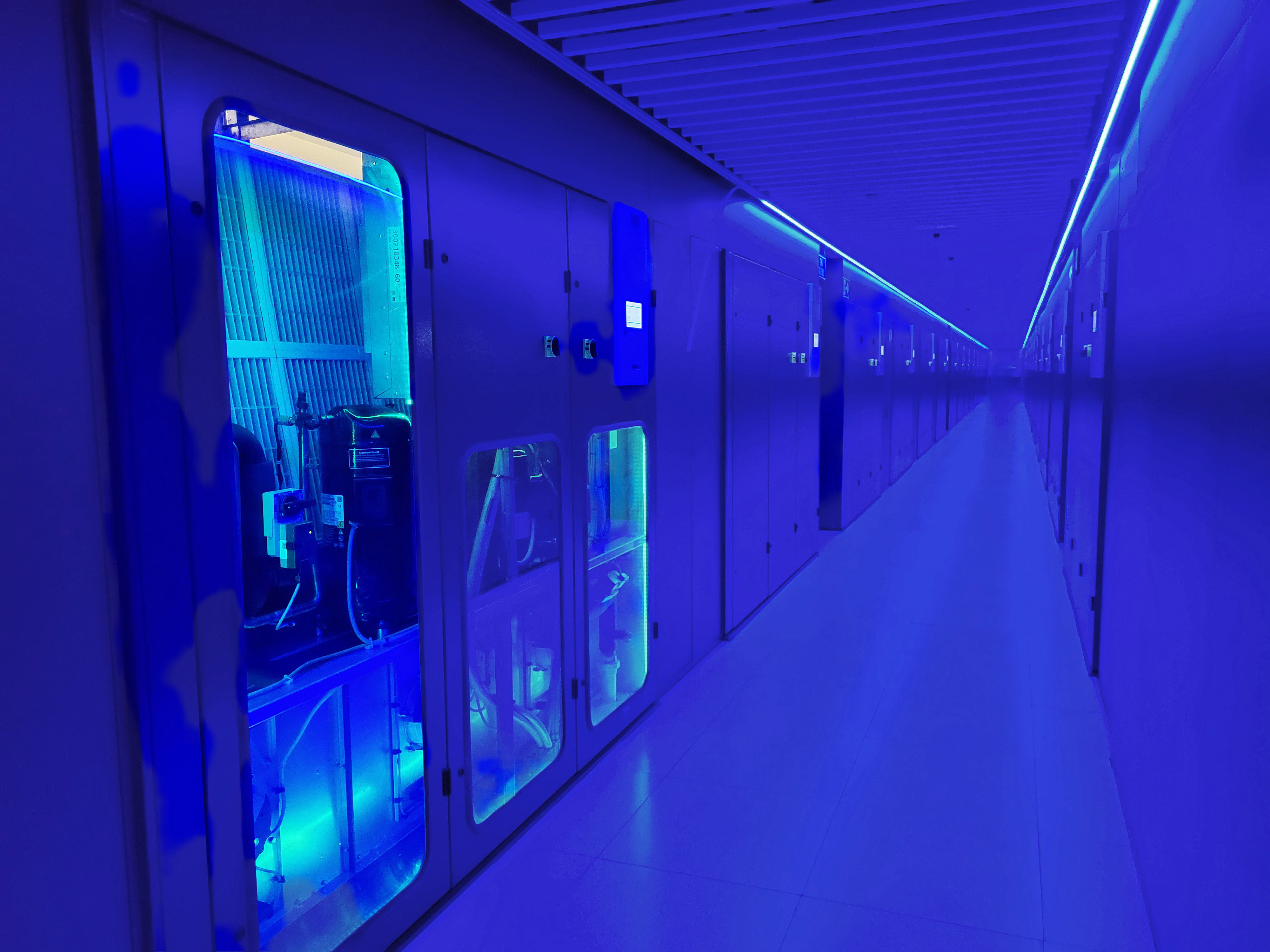
CORRIDOR WITH STULZ EQUIPMENT
One of the major milestones was the installation of a new technical corridor with 51 STULZ units in operation, where the previous 60 kW units were replaced sequentially, keeping the operation unchanged.
As the project manager emphasizes: "We did it with customers inside, changing the previous machines one by one.
It's like changing an airplane engine in mid-flight," he explains in a very illustrative way.
As for the cooling technologies now in use, the facility currently operates with two main systems:
- Traditional CRAC units with closed cold aisles and 80 cm raised floors, which deliver cold air to the racks and return hot air to the room. This system requires proper air containment to prevent hot spots and the mixing of hot and cold air, which reduces efficiency.
- Fanwalls, a more recent and efficient solution that flips the traditional approach: hot air is contained and directed to an upper plenum, while cold air is flooded into the room.
Both systems benefit from the use of indirect air-to-water free cooling. This takes advantage of condensation water temperatures, cooled by cooling towers, to reduce compressor use. “We’re now able to use the free-cooling coil up to 26 or 27 °C of condensation water temperature — something that was unthinkable before,” adds one of the technicians.
Another recent project at Global Switch involved replacing the cooling towers, allowing the system to achieve optimal condensation water temperatures by maximizing outdoor conditions. Combined with the previously mentioned upgrades, this increases the number of hours the free-cooling mode can be used in both CRACs and Fanwalls, improving both effectiveness and efficiency — all without compromising rack thermal stability or service continuity.
4.TECHNICAL DATA AND BENEFITS
The technological transformation undertaken by Global Switch in collaboration with STULZ has had a significant impact in terms of energy efficiency, thermal performance, and reduced operating costs.
One of the most notable figures is the reduction in energy consumption dedicated to cooling — from 24% of the building’s total in July 2023 to just 9% in January 2024, following the equipment upgrade. According to the technical team’s estimates, “energy savings in the renovated areas are around 20%.”
These results stem from the implementation of systems featuring inverter-driven fans and compressors, which can modulate their operation based on the actual thermal load. This reduces temperature fluctuations at the sensors located in customer areas. As the technicians explain, “with the old units, every compressor start-up felt like a jolt; now, the temperature graphs are stable and flat, like a straight line.”
This thermal stability has allowed the facility to safely operate closer to the upper limits of SLA (Service Level Agreement) thresholds, improving overall efficiency without compromising reliability. In addition, the installation has been equipped with advanced monitoring and intelligent control systems — including proprietary software, real-time sensors, and algorithms that adjust operating parameters based on variables such as server activity or pressure in the raised floor.
Looking ahead, the company has already begun designing a new building that will incorporate liquid cooling solutions tailored to workloads of up to 600 kW per rack. “We’re developing an AI Factory in partnership with major players, so customers can come and test high-performance solutions before scaling,” say representatives from the facility’s management. All necessary piping and connections have already been pre-installed to support liquid cooling in specific rooms.
Overall, the upgrade has not only reduced energy consumption and improved the site’s Power Usage Effectiveness (PUE), but also increased the thermal capacity available for new customers and emerging technologies, such as high-density racks used in artificial intelligence applications.
The modernization of the cooling infrastructure at Global Switch’s data center in Madrid, carried out in partnership with STULZ, is a clear example of how precision climate control technology can adapt to the evolving demands of the digital sector.
5. CUSTOMER SATISFACTION
The partnership between Global Switch and STULZ is built on a foundation of trust developed over more than a decade of collaboration.
“For me, it’s about trust — that’s ultimately what I need to convey to our clients” said the data center manager when asked why he continues to rely on STULZ’s precision cooling solutions.
The positive impact of the cooling system upgrades has been evident both technically and operationally. Technicians especially highlight the improvements in thermal stability and energy efficiency: “Thanks to inverter technology and fan control, we can now fine-tune parameters and maintain higher temperatures without risk — something that would have been unthinkable before.”
Additionally, the flexibility of the new systems has allowed replacement and upgrade work to be carried out while customers remained active in the rooms, without any disruption to their operations.
