
The flexible solution to rising performance densities
The framework conditions for designing modern IT infrastructures are currently changing rapidly. While centralized cloud structures continue to form the foundation for most large-scale applications, architectural concepts such as high-density edge computing or AI integration require specialized infrastructures that can scale to meet the high demand for performance density over the long term. In this highly demanding environment, modular data centers are evolving from a temporary niche solution for limited space to a key strategic component for agile and highly available IT environments.
Decentralized AI infrastructure and small Language Models
A key driver of this development is the shift from purely cloud-based systems to specialized, on-premises AI applications based, for example, on Small Language Models (SLMs). As part of their AI strategy, many companies are specifically deploying these compact, parametrically optimized models directly at the source of the data—that is, near production lines and monitoring systems. The goal is to minimize latency, conserve external network bandwidth, and protect digital sovereignty when dealing with sensitive corporate data.
A concrete example of SLM integration can be found in modern high-tech and automotive manufacturing. Here, high-resolution camera systems perform real-time quality control on production lines. An SLM operated locally within the module container analyzes the incoming image and sensor data streams with virtually no delay. This enables the system to immediately detect deviations, compare them with historical quality data, and, if necessary, initiate autonomous corrective actions in the production process. The advantage here is that sensitive design and manufacturing data remain entirely within the physical security architecture of the respective site.
However, this form of edge AI requires high on-site computing power and maximum packing density in a very confined space. Standard server rooms quickly reach their limits here, both architecturally and thermally. The result is a shift toward turnkey, modular data centers specifically designed to meet high thermal requirements.
Design and standardization of modular Data Center architectures
Today, the term “modular data centers” encompasses a wide variety of structural concepts based on standardized units. These are primarily implemented as standardized ISO containers (20 or 40 feet), non-ISO custom containers, or as individually scalable modular structures. Regardless of their general design, however, these systems must comply with strict EN and ISO standards regarding safe operation, physical access control, and fire protection.
As turnkey systems, modular data centers integrate all the critical functions of a traditional data center into a compact footprint. Their transportability and granular scalability allow for precise adaptation to highly specific IT requirements. Short installation and commissioning times at the destination make these solutions ideal for infrastructure environments with no available building capacity, for industrial production, and for sensitive edge scenarios.
Thermal challenges due to rising power densities
The continuous increase in processor performance is fundamentally changing the thermodynamic requirements in data centers. However, since cooling solutions are directly linked to global technology trends, they must adapt in ever-shorter cycles.
This calls for engineering that takes into account the requirements of high-performance computing (HPC), colocation, and cloud structures as early as the design phase of modular systems. The cooling infrastructure can no longer be viewed in isolation; it is an integral part of the overall system architecture. Depending on the power density, different cooling technologies are employed. The choice of the appropriate air-conditioning system has a significant impact on operating costs (OPEX) and long-term reliability.
For traditional IT applications and standardized edge scenarios, precision free-cooling systems have proven their worth in the market. Side-cooling units, such as those in the STULZ CyberRow series, can be installed directly between server cabinets. They remove waste heat from the IT racks and connected UPS systems directly at the source.
In addition to air-cooled systems based on the direct evaporation principle, systems with indirect free cooling or traditional chilled water systems offer high efficiency. These systems are modularly scalable and ensure the required 24/7 operation in compliance with international standards.
Pre-engineered platform solutions for high-density and AI applications
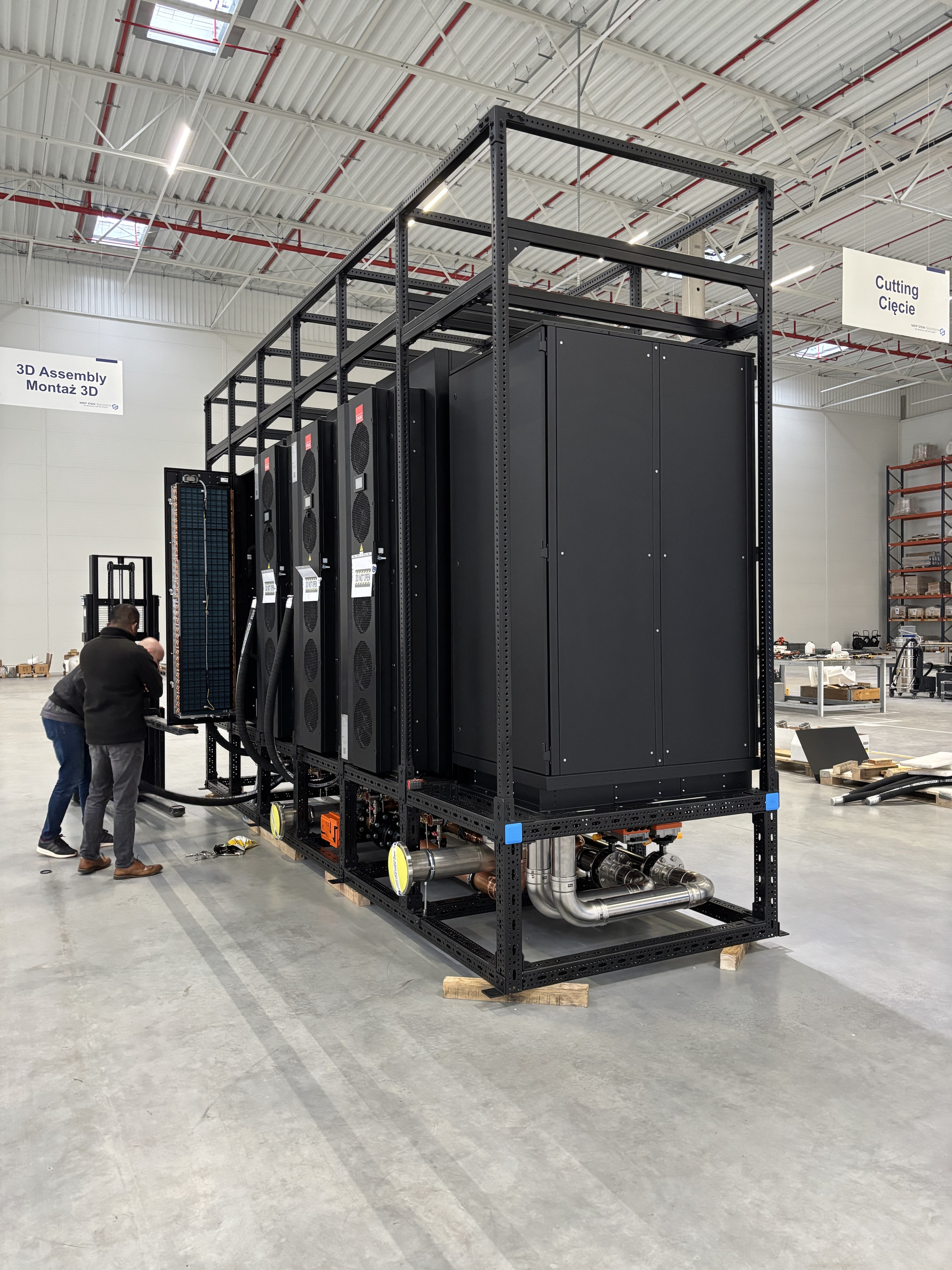
The increasing use of generative AI applications and the continuous processing of local small language models are pushing the physical limits of IT deployment into areas that can no longer be economically supported by air cooling alone. GPU clusters, TPUs, and other high-performance chips make the transition to all-liquid cooling solutions inevitable. Due to space constraints, tight project timelines, and quality management processes, the installation of such infrastructure largely requires a departure from traditional on-site IT installation.
The answer to these challenges lies in turnkey, factory-integrated platforms such as the STULZ 600 kW DLC EMEA Skid. This standardized large-scale assembly combines the entire thermal and electrical IT infrastructure for high-density applications on a single support frame.
