
F-GAS 2027: STULZ solutions for safe and sustainable shelter cooling

The transition to lower-impact refrigerants is transforming the cooling of IT applications. With the new EU F-Gas Regulation 2024/573, the European Union has introduced a progressive phase-down of fluorinated gases with a high GWP (Global Warming Potential), introducing new requirements for manufacturers, equipment manufacturers and users of refrigeration and air conditioning systems. GWP limits, effective dates and safety implications vary depending on whether the application involves outdoor chillers for large data centers or direct expansion air conditioners for shelters, small IT rooms or containerized data centers.

On this page, discover how STULZ is adapting its air conditioning solutions for shelter cooling to this transition, developing new solutions with low-GWP refrigerants that comply with the most advanced environmental standards without compromising the safety, reliability and operational continuity of these critical applications.
The EU F-Gas Regulation 2024/573

The Regulation

Regulation (EU) 2024/573 aims to progressively reduce atmospheric emissions of fluorinated gases with a high global warming impact (F-Gases), which are among the most harmful to the climate, while promoting the adoption of alternative substances. These F-Gases include fluorinated refrigerants used in refrigeration, air conditioning and heat pump systems.

Restrictions

The Regulation restricts the placing on the EU market and the export of refrigerants and products containing them. “Placing on the market” refers to the first making available of goods in the EU, either through sale or transfer by an EU manufacturer or through import; “export” refers to their exit from the EU customs territory. The restrictions do not apply to sales or transfers taking place after the products have first been placed on the EU market.

Limits and deadlines

For STULZ shelter air conditioners, the first step of the Regulation sets out the following requirements:

PLACING ON THE EU MARKET

From 1 January 2027
- Self-contained air conditioners with a rated capacity up to 50 kW: GWP < 150.
From 1 January 2029
- Air-to-air split air conditioners with a rated capacity up to 12 kW: GWP < 150.
- Air-to-air split air conditioners with a rated capacity above 12 kW: GWP < 750.

EXPORT
From the same dates, depending on the product category, products exported outside the EU must have a GWP below 1000.

The supply of products within the EU (for further distribution or incorporation into a final product) for the purpose of exporting the final product outside the EU customs territory is not considered making available on the market. In these cases, the limit applicable to exports therefore applies: GWP<1000.

Derogations

Under Article 11(5), the European Commission may authorize temporary exemptions for specific product categories when no alternatives are available, when such alternatives cannot be used for technical or safety reasons, or when their use would entail disproportionate costs. No exemption request has been submitted for shelter air conditioners, as these conditions do not apply.

Exemptions

Annex IV of the Regulation provides an exemption for specific safety reasons related to the site where the cooling device operates or to the equipment in which it is integrated, such as an electrical enclosure or an outdoor cabinet. Air conditioners and chillers covered by this exemption may use refrigerants with a GWP below 750. Unlike the general derogation, this exemption does not require approval from the European Commission. The burden of proof lies with the operator (end user), who must have a risk assessment supporting the safety reasons.

Overview of technically feasible alternative refrigerants

Traditional refrigerants used in shelter air conditioners (R407C, R410A, R134a) exceed the limits set by the Regulation. Here is an overview of the technically feasible alternatives:

Natural
Low-GWP fluorinated refrigerants
Intermediate-GWP fluorinated refrigerants

Minimal environmental impact, but high application complexity.

  • R290 (Propane): GWP 0.02 | Class A3 (highly flammable)
    Offers excellent energy performance and virtually zero environmental impact, but its high flammability limits its potential applications.
  • R744 (CO₂) GWP: 1 | Class A1 (non-flammable)
    A natural refrigerant traditionally used in industrial refrigeration, it operates at very high pressures and has low efficiency within the temperature range typically required for cooling technical equipment.

Despite their very low GWP, natural refrigerants present application challenges: R290 is highly flammable and poses significant limitations for safe use, while R744 can lead to high energy consumption in technical cooling applications, offsetting the environmental benefit of its low GWP. The choice of refrigerant must therefore take into account not only GWP, but also safety, performance and overall long-term sustainability.

Maximum sustainability, but with flammability to be managed.

  • R1234yf GWP: 0.5 | Class A2L (mildly flammable)
    Provides performance comparable to traditional refrigerants with an extremely low global warming potential.
  • R1234ze GWP: 1.37 | Class A2L (mildly flammable)
    Offers good energy efficiency but requires larger equipment.
  • R454C GWP: 146 | Class A2L (mildly flammable)
    Meets the GWP requirements of the Regulation while maintaining high operating performance.

Although these refrigerants have a low GWP, they are mildly flammable and therefore require specific safety assessments based on the equipment being cooled and the installation environment.

R513A: the non-flammable alternative for safety-critical applications

  • R513A GWP: 631 | Class A1 (non-flammable)
    It is one of the main solutions for applications requiring high safety standards, combining non-flammability with proven performance and broad compatibility with industrial and technical applications.
  • R454B GWP: 466 | Class A2L (mildly flammable)
    Used in a wide range of next-generation HVAC applications.
  • R32 GWP: 675 | Class A2L (mildly flammable)
    Widely used in air conditioning thanks to its good balance between energy efficiency and reduced GWP.

These refrigerants have a GWP between 150 and 750. Self-contained air conditioners and split systems up to 12 kW installed in the EU may use them only under an exemption, where safety requirements or technical constraints make lower-GWP alternatives impracticable. They are, however, permitted in split air conditioners with a cooling capacity above 12 kW. Within this category, R513A is the only non-flammable refrigerant, providing an important advantage in the most critical applications.

STULZ strategy: balancing safety and sustainability

Our approach is based on a simple principle:

providing you with the most sustainable and safest refrigerant for your application.

With this in mind, WallAir4 and TelAir4 self-contained air conditioners for shelter cooling are available with R454C (GWP = 146, mildly flammable) and R513A (GWP = 631, non-flammable). The first version is intended for all end users in the EU where there are no specific safety concerns; the second is intended for export and for EU sites where the use of flammable refrigerants would involve excessively high risks.

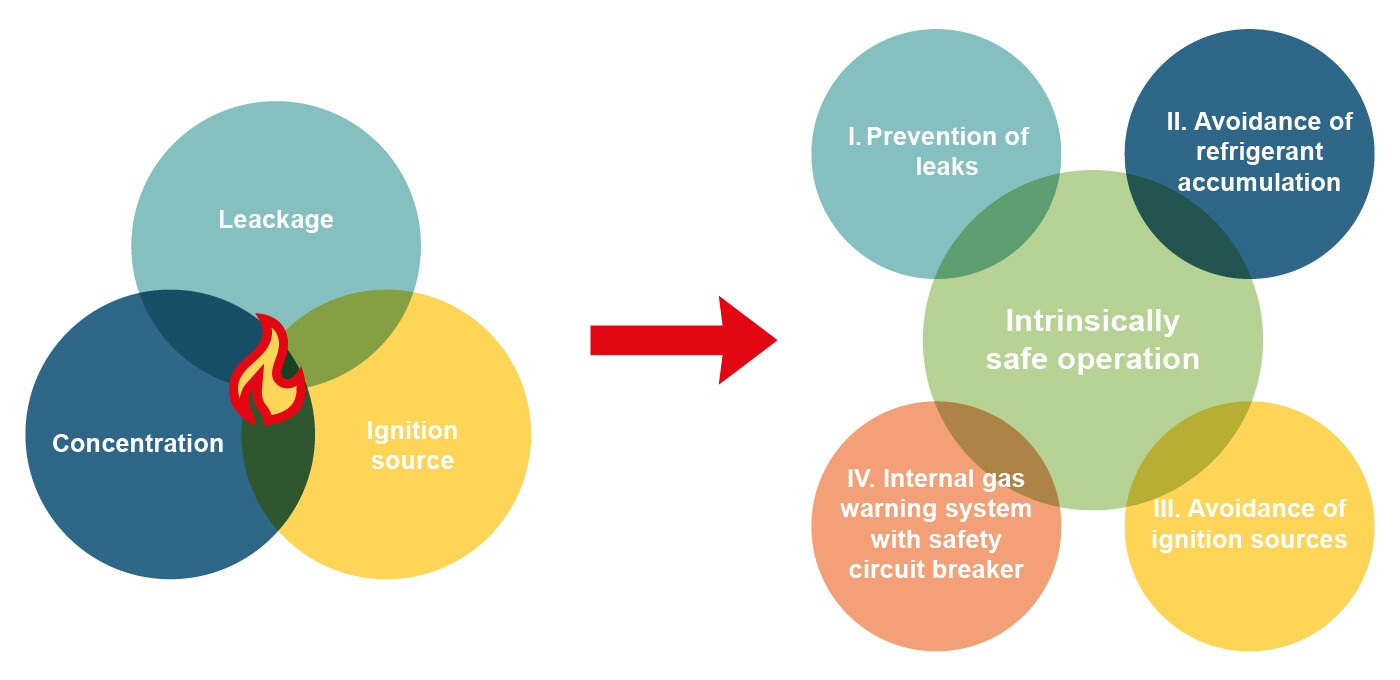
The flammability risk of a refrigerant such as R454C depends on the simultaneous presence of three factors:

  • leakage from the refrigerant circuit;
  • a refrigerant concentration resulting from leakage that exceeds the LFL (Lower Flammability Limit) in specific areas;
  • the presence of ignition sources in those areas (sparks, electric arcs, surfaces with temperatures above the ignition temperature, open flames).

The use of flammable refrigerants, even A2L refrigerants, in cooling equipment requires a rigorous approach based on the intrinsic safety of the air conditioner, but it must also be supported by a thorough risk assessment of the installation site. The safer the air conditioner itself is, the lower the residual risks that the operator must consider and manage to ensure the overall safety of the site.

Designing a system with an A2L refrigerant does not simply mean replacing the refrigerant and selecting compatible components: designs developed for non-flammable refrigerants are no longer adequate and must be rethought. STULZ ensures the intrinsic safety of its WallAir4 and TelAir4 air conditioners with R454C by:

  • minimizing the risk of refrigerant circuit leaks through the appropriate selection of components, materials and joining techniques, ensuring that the circuit is hermetically sealed;
  • compartmentalizing refrigerant circuit joints, which are the most likely leakage points;
  • preventing contact with ignition sources: the electrical enclosure is sealed, and the maximum surface temperatures of components remain well below the ignition temperature;
  • immediately detecting critical refrigerant concentrations within the air conditioner and, when specific thresholds are reached, ventilating the most critical areas or disconnecting the power supply.

Further details on the safety of STULZ products are available in the following article: A New Era for Data Center Refrigerants.

Safety does not end with the air conditioner: refrigerant can leak from the evaporator side into the room being cooled, or from the condenser side to the outside. The operator must carry out a risk assessment on the room side and also on the outdoor side if this is itself an enclosed space and the refrigerant is not discharged directly into the atmosphere. The following aspects must be assessed:

  • Room volume: the refrigerant charge per circuit must not exceed the maximum value specified by EN 378 based on the room classification and occupancy category.
  • Ventilation: the technical room must be equipped with dedicated ventilation systems and a leak detection system connected to the site management system.
  • Safety zones: it is essential to identify areas in the room where the refrigerant concentration may exceed the flammability limit. These are typically located around the air conditioner’s air discharge or at floor level, where R454C refrigerant can accumulate because it is heavier than air. No ignition sources are permitted in these areas.

If the site risk assessment shows that the residual risks are too high, a safety exemption may apply. For these sites, STULZ offers WallAir4 and TelAir4 air conditioners with non-flammable R513A refrigerant.

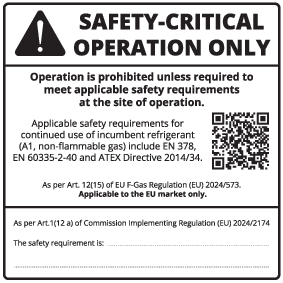
TelAir4 and WallAir4 units with R513A will carry the label shown here. This indicates that their use in the EU is permitted only where safety reasons prevent the use of flammable refrigerants. The operator (end user) of the cooling equipment, or of the system in which it is integrated, must have a risk assessment documenting the safety reasons on which the exemption is based.

A look to the future

SplitAir air conditioners with traditional R407C and R410A refrigerants will remain available until mid-2028, as the restrictions under the Regulation for this type of air conditioner will come into effect on 1 January 2029. STULZ is already working on the development of new SplitAir units using the low-GWP refrigerant R454C, following the same approach adopted for its self-contained air conditioners.

The second step of the Regulation will come into effect on 1 January 2032 for self-contained air conditioners and on 1 January 2035 for split systems. For all units with a cooling capacity of up to 12 kW, fluorinated refrigerants will be completely prohibited. Only natural refrigerants will remain an option, although these present significant safety challenges.

In the meantime, a revision of the REACH Regulation governing the use of chemicals is expected, which could further complicate the regulatory landscape by restricting the use of most fluorinated refrigerants, including R454C and R513A.

In this uncertain environment, STULZ will continue to monitor technological and regulatory developments in the market and will adapt its strategy if new solutions emerge that can combine environmental sustainability, safety and economic competitiveness even more effectively.

Our objective remains unchanged: to support our customers in achieving their environmental sustainability goals while ensuring operational reliability, continuity of supply and full regulatory compliance.

For a technical discussion on the F-Gas Regulation and safer, compliant cooling solutions for technical rooms, do not hesitate to contact us!

A New Era for Data Center Refrigerants