
Unique acoustic test validates Data Center chiller performance
STULZ and Merford set a new Standard
In the world of data center cooling, attention is increasingly shifting from capacity and energy efficiency alone to an equally critical theme: noise. As data center power density continues to rise, the number and size of chillers increase accordingly. As a result, the impact on the surrounding environment grows, and noise requirements imposed by permitting authorities become stricter and more specific.
Recently, STULZ and Merford conducted a unique acoustic test on a newly developed chiller for a current project. The test was carried out at STULZ S.p.A. in Valeggio sul Mincio (Verona, Italy). What makes this test unique is that comprehensive measurements of a chiller, performed under realistic operating conditions and according to a fully validated methodology, are rarely conducted in this way in the market and publicly shared.
Noise as a design parameter in Data Center Cooling
Data centers increasingly operate in environments with strict noise limits for daytime, evening, and nighttime periods. For the project in question, maximum noise levels of up to 80.2 dB(A) apply at night. These limits can only be achieved when noise control is integrated into the design phase of the complete chiller configuration, including the noise attenuation system.
In collaboration with Merford, a specialist in noise control, doors, and custom acoustic solutions, STULZ developed a fully integrated noise attenuation system for this type of chiller. The objective was clear: demonstrably comply with statutory noise requirements without compromising cooling capacity, efficiency, or operational reliability.
As Davide Mazzi, Head of the STULZ Application Team at STULZ S.p.A., explains in the accompanying video:
“The greatest challenge was not only to guarantee efficient cooling, but above all to comply with extremely strict noise limits. The installation is located on a rooftop in a densely built urban environment. Our task was to deliver the required performance without disturbing the surroundings and without compromising the operational reliability of the data center.
Controlled and reproducible measurements according to EN ISO 9614
The measurements were performed in accordance with EN ISO 9614-2:1997, the international standard for determining sound power by means of sound intensity measurements. The sound power level was determined by scanning the entire measurement surface surrounding the chiller. To ensure reliable measurements, a thorough environmental analysis was carried out in advance. Using a 3D acoustic model in SoundPLAN, specialized software for sound propagation calculations based on ISO 9613-2, the test setup was optimized. It was ensured that the background noise level was at least 10 dB below the measured source sound power.

At the production site, a carefully selected test location was defined, along with a deliberate positioning of supporting equipment such as a transformer, boiler, and pump skid, ensuring that their noise did not influence or interfere with the measurement. Our approach underlines that a credible acoustic test for data center cooling, in this case a chiller, goes beyond a single snapshot measurement. It is a controlled, reproducible, and standards-based process.
Two attenuation concepts, one validated solution
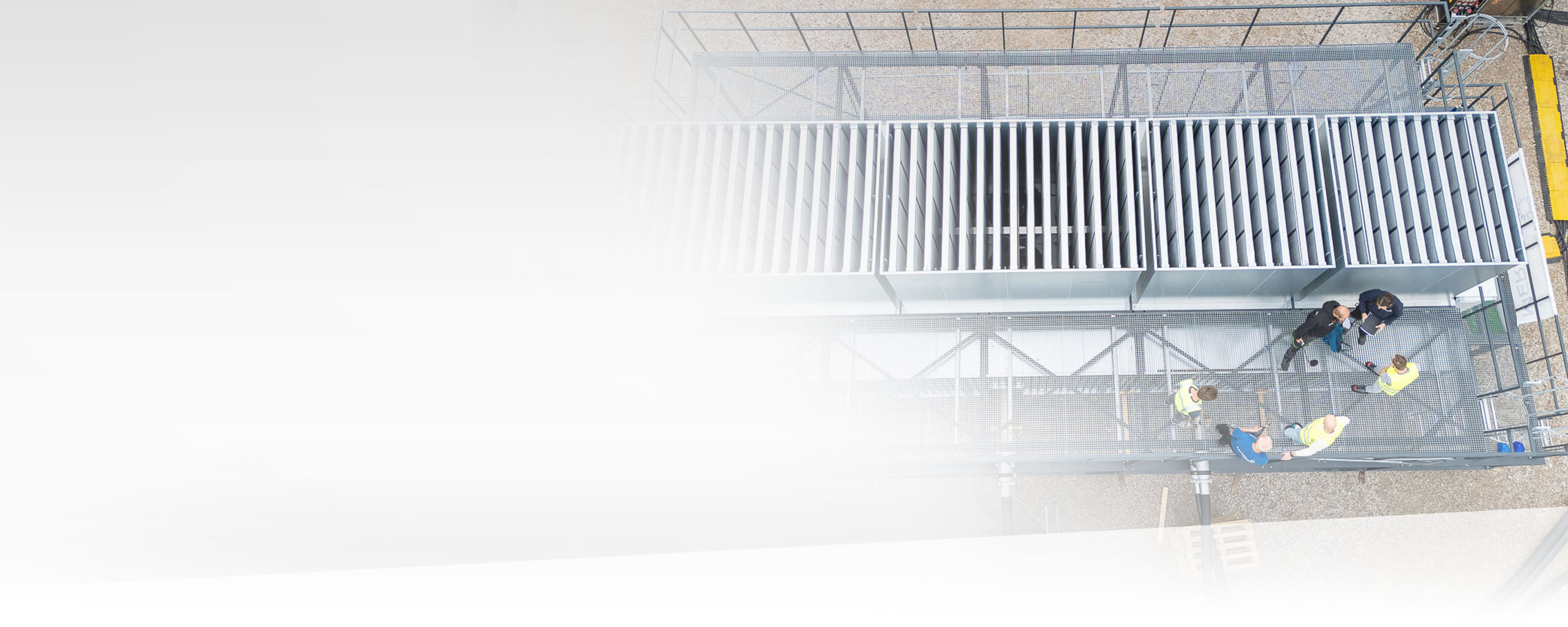
During the test, two noise-attenuation concepts were evaluated. Both variants featured a steel-frame construction with integrated attenuators around the chiller, designed to reduce airborne and structure-borne noise.
The first concept was designed as a robust baseline solution providing broadband noise reduction. The second concept went a step further, incorporating additional acoustic optimizations and additional source-control measures to maximize the reduction in total sound power.
This more extensive configuration delivered demonstrably higher noise reduction, with increased weight and structural complexity as a deliberate design trade-off.

By measuring the sound power level with and without the attenuation system, the exact noise reduction can be objectively verified against statutory requirements. In this way, we not only substantiate the theory but also demonstrate, in practice, that the solution complies with the standards set by legislation.
As Davide Mazzi summarizes in the video:
“To demonstrate the effectiveness of our solution, we recreated the actual installation situation. We built a steel structure to simulate the rooftop installation and conducted two measurements: one without attenuators and one with the full noise attenuation system in operation. This shows that it is not a solution on paper, but a technology that works in practice.”
The test results confirm successful performance. The chiller equipped with the developed noise-attenuation system meets the specified noise requirements. With this, STULZ and Merford demonstrate that high-performance data center cooling and strict acoustic criteria can go hand in hand, provided that design, engineering, and verification are approached in an integrated manner and close collaboration is established from the outset.